
“Not climate leadership. It is climate hypocrisy”: Peoples’ Summit denounces wealthy countries with “empty hands” and demands historical reparations.
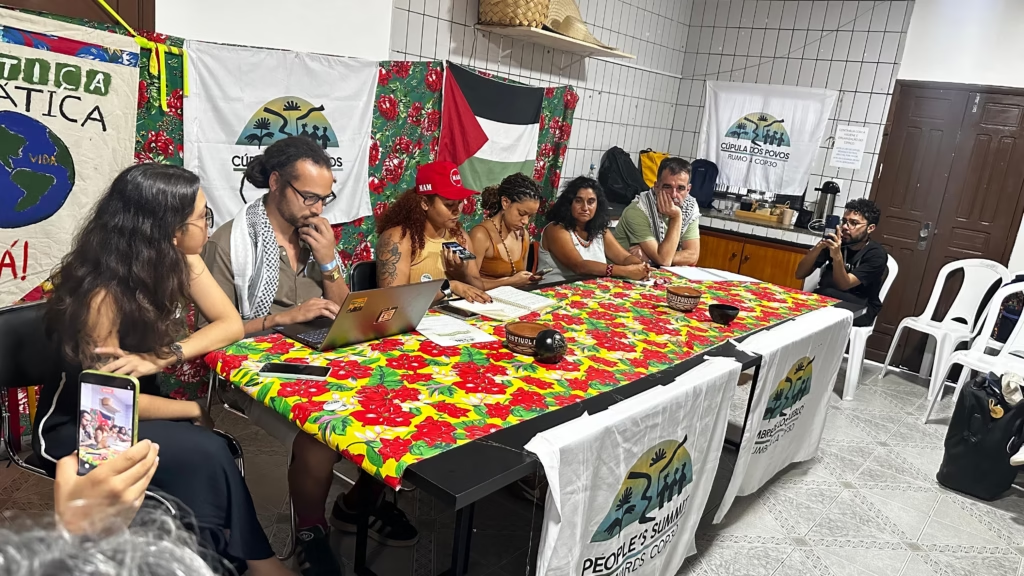
Press conference held at the Peoples’ Summit House to evaluate the Leaders’ Summit, which ended this Friday, criticizes the lack of commitment to ending fossil fuels, warns of the capture of Amazon protection mechanisms by the market, and reaffirms the struggle agenda based on six thematic axes. The articulation released a statement with its political position. In direct counterpoint to the COP30 Leaders’ Summit, the social movements and popular organizations that make up the Peoples’ Summit held a press conference this Friday (7) to mark their position and denounce the inaction of Global North countries. The event took place at the Peoples’ Summit House in Belém (PA) and brought together representatives of the Climate Action Network (CAN International), the Movement for Popular Sovereignty in Mining (MAM), the Global Campaign for Climate Justice (DCJ), and La Vía Campesina (LVC). The “empty truth” COP and the injustice of climate finance The main criticism was directed at the absence of real commitments from rich nations. Jacobo Ocharan (CAN International/Mexico) highlighted the expectation that COP30 would be the “COP of Truth,” but lamented the lack of concrete action: “So far, there is little truth and a great void of commitment from the countries historically responsible for the climate crisis.” Ocharan denounced that rich countries arrived “empty-handed, without realistic national plans (NDCs) or concrete commitments to the progressive elimination of fossil fuels.” Unjust energy transition and environmental racism Brazilian representative Isabely Miranda (MAM/Brazil) questioned the concept of “energy transition” promoted by governments, describing it as a mere “energy expansion” imposed from above. The MAM activist criticized the transition model based on mineral extraction and the disparity between hemispheres. She emphasized that solutions must come from communities, calling for real accountability from corporations responsible for destruction: “Big mining companies, industries, and agribusiness need to stop killing us and killing nature.” Reparation, not charity: the critique of climate hypocrisy Activist Tyrone Scott (DCJ/United Kingdom/Jamaica) brought the voice of small island nations, recalling the recent Hurricane Melissa in Jamaica and denouncing debt and historical exploitation. Scott condemned the hypocrisy of nations enriched through colonialism and slavery: “What the world needs is not charity, but justice.” He criticized market-based mechanisms and condemned governments that expand fossil fuel extraction: “This is not climate leadership. It is climate hypocrisy.” The message was reinforced by Jyoti Fernandes (La Vía Campesina/United Kingdom/India): “Reparations, not charity.” LVC defends public climate financing, rejecting private, conditioned, and neocolonial funding models, and affirms: “We believe in life. And that is what we fight for.” Convergence of struggles and strategic axes Beatriz Moreira (Operational Secretariat of the Peoples’ Summit/MAB) recalled that the Summit’s process began two years ago and now brings together more than 1,100 organizations, starting in Belém in solidarity with victims of violence in Pará. The Peoples’ Summit is organized around six strategic axes that guide its plenaries and mobilizations: Climate Justice and Reparation. Just, Popular, and Inclusive Transition. Food Sovereignty. Territorial and Forest Rights. Internationalism and Solidarity. Feminist and Territorial Perspectives of Peoples. Beatriz concluded by reinforcing the autonomy and organizing power of the movements: “If there is a solution to the imbalance we live in, it lies within us — the peoples who inhabit and defend the territories.” Next steps The Peoples’ Summit will have an intense program starting on the 12th, focused on plenary discussions about the six strategic axes, drafting of the Peoples’ Charter, a boat action, a climate justice march, a collective banquet, and a meeting with the COP30 presidency.
The “Carbon Zero” Change Fleet arrives in Belém to challenge the fossil fuel lobby at COP 30.
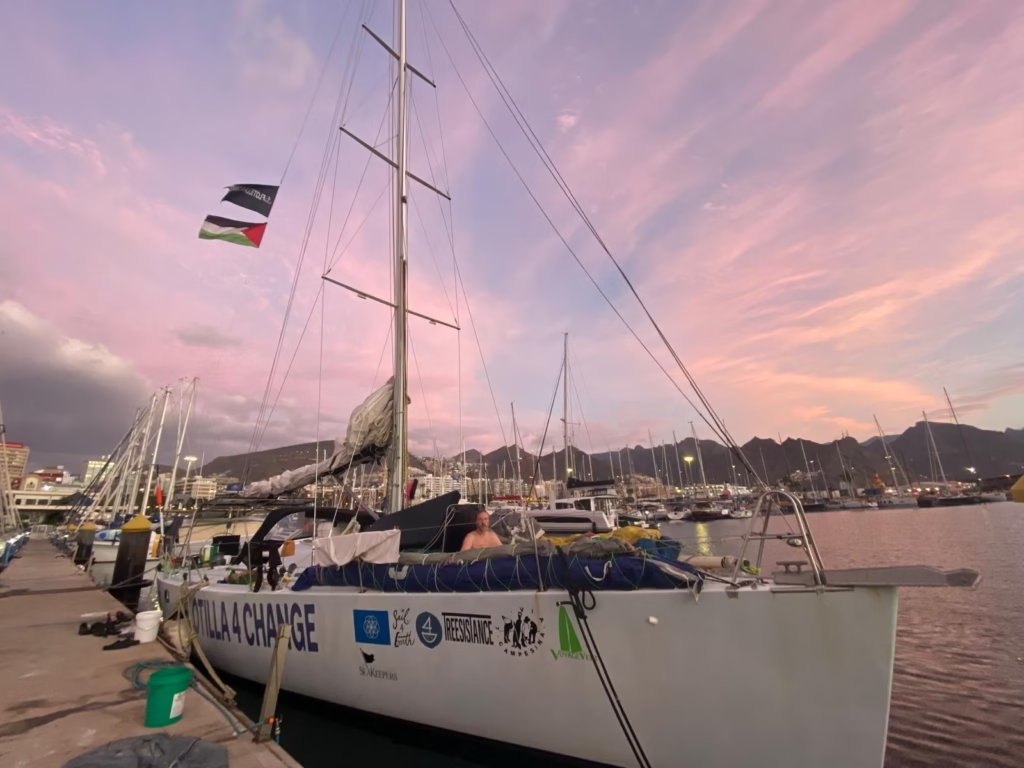
BELÉM, PA – A fleet of six sailboats, named the Flotilla for Change, is heading to Belém, bringing a delegation of around 50 activists, scientists, and delegates from different parts of the world. The transcontinental mobilization, whose flagship vessel is the Sababa (which departed from New Zealand and sailed 17,500 miles), represents an act of popular leadership and climate action in practice, contrasting sharply with the high carbon footprint of aviation that fuels the United Nations Climate Change Conference (COP30). Organized in solidarity with the Convergence Axes of the People’s Summit, the Flotilla embodies the urgency of Climate Justice and the defense of territories and “sea territories.” The journey included stops in Santa Cruz de Tenerife and Mindelo, Cape Verde, and brought crucial voices from the Global South to the Amazon, such as activist Melody Barry-Yobo from Ogoniland, Nigeria, who connects the struggle against fossil fuel extraction in the Niger Delta with the Amazonian cause. A Battle of Narratives Upon arriving in Belém, the Flotilla’s mission is clear: to challenge the narrative of the official conference, which activists say is dominated by corporate interests. “We want to confront the fossil fuel industry. It will once again be present at the Conference, carrying out massive lobbying, and that’s why it is so important that the global Climate Justice movement is also there,” says Katharin Henneberger, former member of the German parliament and crew member of Flotilla for Change. The activists’ decision to travel by sailboats serves as a floating laboratory and a public demonstration that climate leadership begins with practice, rejecting high-emission modes of transport. Citizen Science and Diversity on Board On board the sailboats, the crew operates as a citizen science laboratory, conducting research on ocean health, including plastic monitoring and the collection of data on wildlife and water quality. The composition of the crew directly reflects the Summit’s commitment to diversity. Land and sea workers, anti-racist and LGBTQIA+ activists, scientists, delegates, and youth from multiple nationalities sail together. The Flotilla requires all members to undergo mandatory Cultural Sensitivity and Anti-Racism training, reinforcing that the climate struggle is inseparable from social justice. Agenda in Belém The Flotilla will remain in Belém until the end of November and has an intense agenda within the People’s Summit: November 13–14: Participation in the People’s Summit program, with a focus on the axis “Living Territories and Sea Territories, Popular and Food Sovereignty.” November 14: Roundtable and Listening/Learning Event on board the Rainbow Warrior, docked at the Federal University of Pará (UFPA), Rua Augusto Corrêa, 01. November 15: Mass participation in the People’s Summit’s closing Popular March.