
Social Leaders and Participants of the People’s Summit at COP 30 Discuss Climate Future and Unify Global Struggles
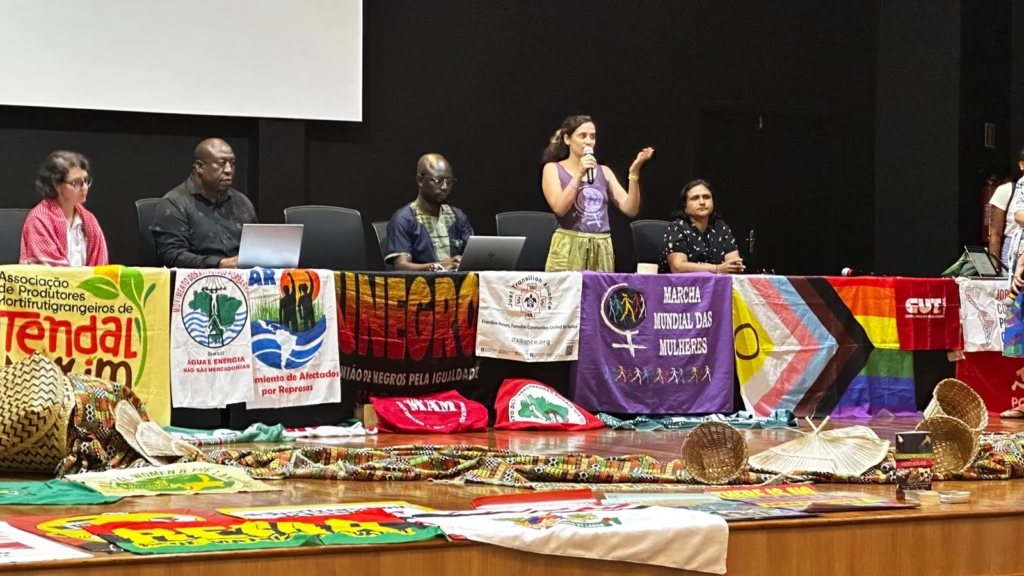
BELÉM (PA) – The discussion on the climate and social future took center stage in Axis 3 of the People’s Summit Plenary, with the participation of important leaders advocating for a radical transformation of current economic models. The debate brought together global and grassroots perspectives, focusing on deconstructing the system of exploitation and commercialization of natural resources and guaranteeing rights for the peoples of the Global South. Demand for Systemic and Democratic Transformation Fernando Tormos-Aponte, a political sociologist, researcher, and member of the Just Transition Alliance in the United States, articulated the need for a change that goes beyond market solutions. His speech pointed directly to the structural root of the crises: “We are demanding to go against the capitalist, racist, and patriarchal system that consistently prioritizes profit and accumulation over life and nature. We see the impact of this system in the privatization of all social services, where what does not generate profit is not worthy of attention. We therefore propose a different system that does not put profit before life. And for that, we must have a systemic transformation. We know that this transformation is a process that leads to other people being affected by these transitions. And this is a bet on democracy.” The perspective of the Brazilian working class was brought by Rosalina Amorim, National Secretary for the Environment of the Unified Workers’ Central (CUT), who highlighted the urgency of democratizing energy. Rosalina vehemently criticized the way the energy transition has been implemented, without guaranteeing access for the most remote communities and penalizing the working class. She reinforced that it is necessary to be at the forefront of the discussion to ensure that energy does not become another factor of exclusion and that the working class is not the main victim of this process. Activist Farai Maguwu, Founding Director of CNRG (Centre for Natural Resource Governance) in Zimbabwe, joined the discussion, bringing the African perspective on the fight against the exploitation and commercialization of natural resources and the human rights abuses linked to this trade. His work, especially in denouncing crimes related to diamonds in Zimbabwe, reinforces the need to control transnational capital and guarantee sovereignty over natural resources. The consensus in the Axis 3 Plenary is that the Just and Popular Transition must be a process guided by democracy, social justice, and the abandonment of a system that puts profit above life. The Common Thread: Pain Unifies Global Struggles at the People’s Summit The Plenary of Axis 3 of the People’s Summit opened space for a moment of fundamental importance: the direct sharing of the pain and injustices felt in different parts of the world. The power of this moment lies in the realization that, although they work in different countries and organizations, activists are driven by a common impulse: confronting the ills generated by the same capitalist and exploitative system. The narratives converged in a single direction, proving that the crisis is systemic. Maria das Graças Lima Bento, affected by the Samarco, VALE, and BHP crime (the Fundão dam collapse in 2015) in Mariana, brought the drama experienced in Barra Longa, Minas Gerais. Describing the devastation of the sludge that compromised planting areas and family income, she stressed that the struggle for conquered rights — such as the Income Transfer Program (PTR) — has already lasted ten years, and that her participation is in solidarity with all those affected, whether by dams or other forms of exploitation. This fight against the denial of rights finds an echo in the direct critiques of power structures. Moira, a Mapuche activist from Patagonia, made a strong appeal for a change in political paradigm, advocating that land be recognized as a historical and social subject in democratic discussions, and not just people. She sharply criticized the current “country models that deny the rights of indigenous peoples and, above all, that deny the land,” classifying South American nations as “colonial republics.” The global responsibility for this structure was highlighted by Tyrone Scott, from the British organization War on Want. Scott defined the Summit as a collective process of imagination and organization of movements from Latin America, Africa, Asia, and Europe that refuse to see the idea of transition being “captured” by the status quo. Scott drew attention to the historical and ongoing responsibility of the Global North for the climate chaos and ecological death, arguing that there can be no just transition in the South without wealthy nations and corporations being held accountable for causing the crisis. In essence, the speeches, united by the same motivation, echo the criticism made by Rosalina Amorim (CUT Brazil) at another point in the plenary: the rejection of any energy transformation that is implemented without guaranteeing access to the most remote communities or that penalizes the working class, reinforcing the urgency of democratizing energy and resources. The collective clamor is clear: the pain of capitalist exploitation is the driving force for building a unified front for a just future. Conclusion With the conclusion of the contributions, the Axis of the Just, Inclusive, and Popular Transition concludes, celebrating the Unity and Hope that mark the spaces of the People’s Summit. The synthesis document, enriched by the contributions of nearly 30 activists, will now proceed to the Final Declaration, and all participants are invited to proceed to the Solidarity Tent, where they will meet with the other axes in a crucial step towards the consolidation of a unified front of struggle. Photos: Samara Silva/Ag.EficazPress
Women who Move Territories: Popular Feminism as a Force of Resistance at the Peoples’ Summit at COP30
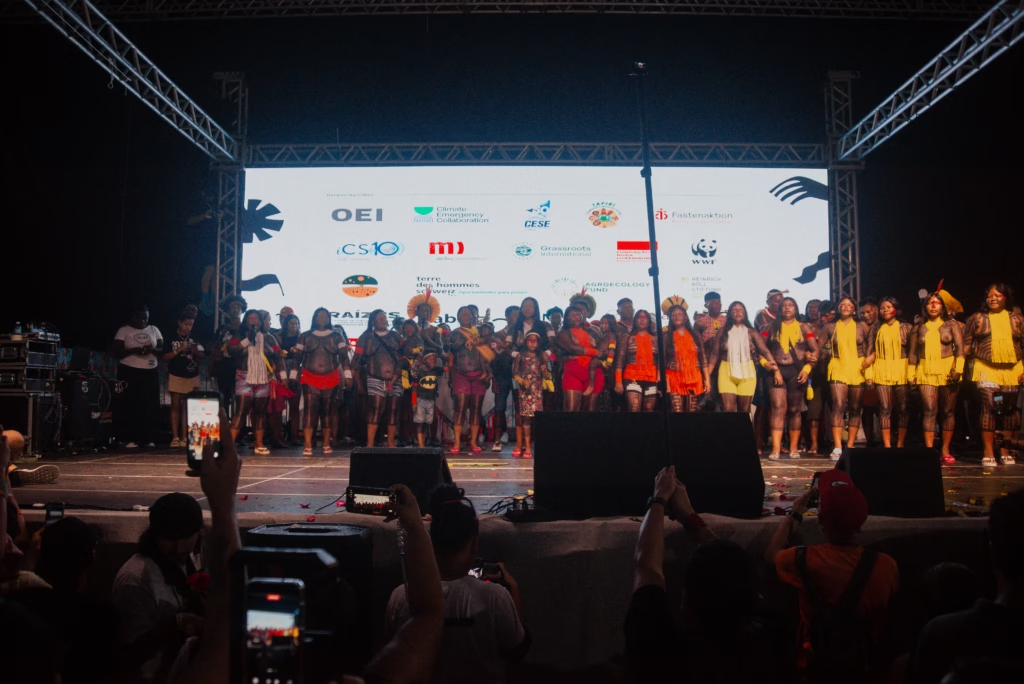
Belém (PA) 11/13/25 — At the Peoples’ Summit, the debate on popular feminism and women’s resistance in their territories reaffirms the political and transformative power of women who, for decades, have sustained the struggles for social, climatic, and environmental justice. It is they—Indigenous, Black, Quilombola, riverside, fisherwomen, peasant, and urban women—who, from different corners of the country and the world, bring their voices and experiences to the center of the discussion about the planet’s future. Today, more than ever, it is known that where there are women, there is standing forest, quality food being planted, and communities resisting the advancement of the corporations responsible for the climate crisis. According to Eunice Guedes, an articulator for the World March of Women (MMM), this agenda is born from a collective and historical construction. “This struggle comes from afar. Since the Rio de Janeiro Forum in 1992, when we created Planeta Fêmea (Female Planet), we have continued to reaffirm that the rights of women and girls—in all their diversity—are fundamental in the defense of life and territories,” she states. She emphasizes that climate and environmental crises affect populations unequally and have a direct impact on women, girls, and trans people in vulnerable situations. “These tragedies are not accidental. They have structural causes and primarily affect women in the Global South, who lose their homes, their loved ones, and often face violence in shelters and displacement spaces,” she warns. Ediene Kirixi, a leader of the Munduruku people, led the March in Defense of Territory and Against Large Projects and Carbon Credits through the Peoples’ Summit space alongside chieftains, women warriors, and men warriors, denouncing threats to territories and traditional ways of life. In her speech, she highlighted that popular feminism is also a form of resistance and re-existence. “Our bodies and territories are targets of attacks, but they are also spaces of care and strength. It is we who sustain life in the communities, who care for the land, the water, the home, and the elders. Talking about climate justice is also talking about gender, race, and territorial justice,” she declared. Among the agendas defended by axis 6 are the right to territory, free access to babaçu palm groves, and the strengthening of agroecological and solidarity-based agriculture and extractive activities, as ways to guarantee autonomy, food sovereignty, and the conservation of socio-biodiversity. The debate reaffirmed that there is no ecological transition or climate justice without women on the front line. It is they who, with ancestral wisdom and collective strength, move territories, build alternatives, and point to new horizons for coexistence between peoples and nature. Picture: Carolynne Matos
Peoples’ Summit Demands Real Solutions and Warns of the Risk of Climate Injustice in Belém
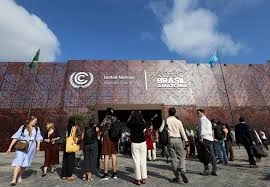
BELÉM/PA — While the United Nations Palace prepares to host the Heads of State and negotiators of COP 30, social movements and grassroots communities from Brazil and around the world are organizing autonomously. The Peoples’ Summit Towards COP 30 emerges in Belém as the cry of those on the front lines of the crisis, confronting the official agenda that, historically, privileges the market and corporate interests to the detriment of life and territories. The Summit’s diagnosis is incisive: the climate crisis is, above all, a crisis of injustice — racial, social, gender, and colonial. If COP 30 fails to incorporate the popular agenda, it will merely be another stage for the legitimization of “false solutions.” The warning is clear: the focus on market mechanisms, such as the financialization of nature, and the omission regarding the ecological debt of Global North countries and corporations, will condemn the Amazon and other biomes to the deepening of environmental racism and corporate impunity. The struggle is against unsustainable extractivism and the failure to impose an energy transition that is, in fact, just and popular. The Power of Convergence: Six Pillars for Well-Being (Bem-Viver) with Respect for Life and the Environment To reverse this scenario, the Peoples’ Summit — which brings together Indigenous peoples, quilombolas (descendants of runaway slaves), youth, women, and workers’ movements — organized its resistance and proposal into six strategic pillars. These pillars are the materialization of solutions that come from the grassroots: Living Territories and “Maretories” (Coastal/Marine Territories): For land demarcation, food sovereignty, and the recognition of Nature as a subject of rights. Historical Reparation: For combating Environmental Racism, false solutions, and demanding that the Ecological Debt be paid. Just, Popular, and Inclusive Transition: For ending the fossil fuel era and building an energy democracy, based on popular knowledge. Against Oppressions: For the struggle for democracy, the internationalism of peoples, and against the far-right and fundamentalisms. Just Cities and Living Urban Peripheries: For combating environmental racism in urban areas and democratizing access to sanitation and energy. Popular Feminism: For the leadership of women in the territories and the uncompromising defense of reproductive and sexual rights. Final Letter: The Popular Tool for Global Pressure The convergence point for all this mobilization and discussion will be the drafting of a Final Letter of the Peoples’ Summit. This letter will not be just a formal document. It is conceived as a popular tool for international political pressure, which will synthesize the collective denunciations, proposals, and demands of global social movements. The text, forged in the struggle and discussions within the territories, will be a popular mandate to pressure governments, corporations, and the United Nations (UN) itself to transcend cold climate negotiations and adopt the path of Climate Justice and Well-Being (Bem-Viver). The message is clear: the solutions will not come from the closed rooms of the COPs, but from the power and articulation of the peoples. At the closing of the Peoples’ Summit on the 16th, the Peoples’ Declaration Letter, collectively built by members of over 1,100 entities and movements from 62 countries, will be delivered to Ambassador André Corrêa do Lago, president of COP30. There is an expectation that President Lula will be present on this day. Picture:Zé Netto/AG>Eficaz Press
International Seminar Highlights Pathways Toward a Just, Popular and People-Led Energy Transition
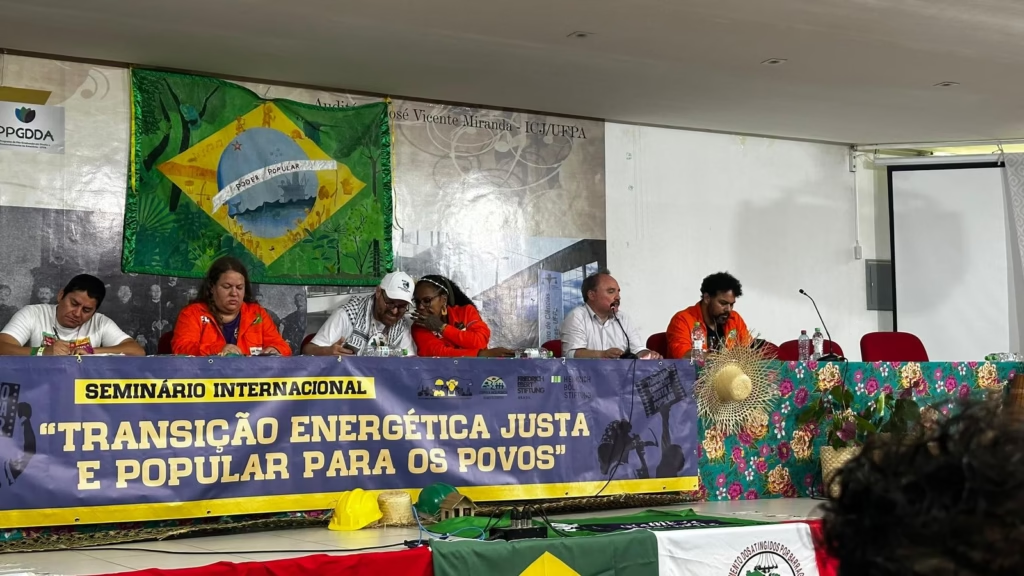
November 14, 2025 – Belém, Pará – The international seminar “Just and Popular Energy Transition for the Peoples”, held during the People’s Summit at COP30, brought together community leaders, workers, social organizations and representatives from several countries of the Global South to debate pathways toward a transition capable of confronting inequalities, reducing environmental impacts and guaranteeing energy sovereignty for territories. The meeting emphasized that the currently dominant models—based on financialization, megaprojects and the expansion of sacrifice zones—do not meet the needs of peoples and instead deepen historical injustices. Speakers stressed that a just transition is only possible with social participation, decentralization, appropriable technologies, and recognition of the rights of workers and affected communities, represented by the Movement of People Affected by Dams (MAB) and the Movimiento de Afectados por Represas (MAR). Opening the debate, representatives of popular movements argued that the energy transition must break with fossil fuel corporations and the financial market, which are responsible for the climate crisis and for decades of territorial exploitation. The central call was for energy democracy, with community control, social justice and public policies that prioritize those who suffer most from the impacts of the climate crisis. The seminar also included a round of testimonies from victims of environmental disasters, bringing the concrete perspective of territories that live with the consequences of predatory development models. A poem-performance emphasized that resistance is born from the aggression experienced by peoples, reinforcing that affected communities must be recognized as protagonists of energy transformation. Gery, a worker from the oil sector in the United States, denounced that market-driven transitions have left entire communities behind, leading to refinery closures, unemployment and abandonment. “The transition, as it is being carried out, creates more poverty and more suffering,” he warned. From Venezuela, Eduardo Castilho, from the Ecosocialist Front for Life, criticized the logic of megaprojects and defended decentralized and interconnected systems that strengthen popular autonomy. According to him, every energy matrix requires some level of extraction, and therefore life must be placed at the center of the transition process. From Pakistan, Hussam Jarwar denounced pressure from international financial institutions to replace coal with gas, LNG and hydropower without consulting local communities. He stated that this model deepens debt, raises energy costs and weakens workers, women and youth, reinforcing the need for international articulation against imposed transitions. Representing Mozambique, a community leader reported the advance of extractivism in previously self-sufficient territories, denouncing the destruction of ways of life and the growing dependence on food imports. In her remarks, she highlighted the role of African women as guardians of the land and defended territorial sovereignty and sustainable models aligned with local realities. Closing the interventions, Beatriz Dias, a young Amazonian woman from the state of Amapá, demanded the effective presence of youth—especially those from peripheral, Black, Indigenous and Quilombola communities—in COP30 debates. For her, discussing the future and the climate without ensuring youth leadership is to deny the very right to a future. The seminar reaffirmed that a truly just energy transition is popular, territorialized and built from the needs of peoples, grounded in democracy, community-based solutions and the confrontation of the extractivist model that fuels the climate crisis. Photos: Samara Silva / Ag. EficazPress
During the Barqueata, Chief Raoni calls for unity between Indigenous and non-Indigenous peoples in defense of the Amazon

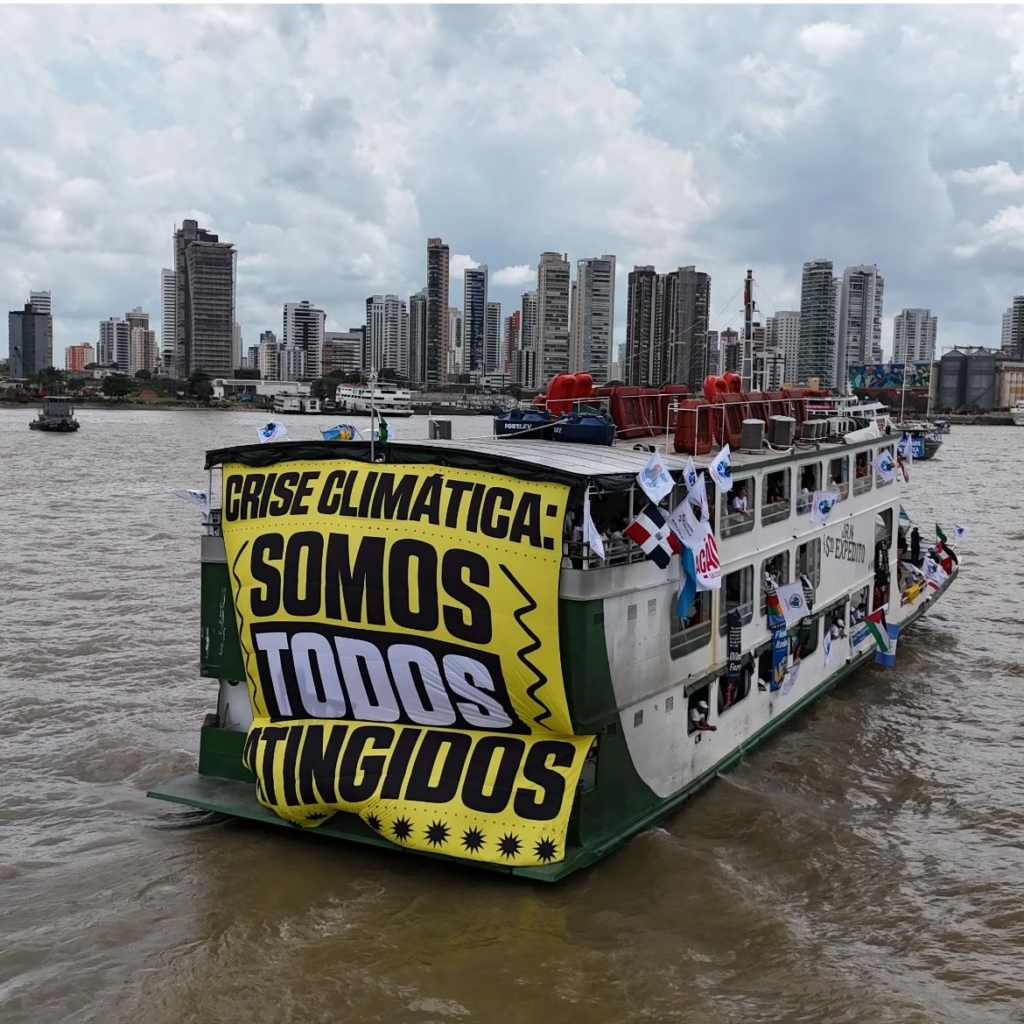
River march opens the Peoples’ Summit towards COP 30 in Belém to show the world that the response to the climate crisis lies in living and free territories Belém (PA), November 12, 2025 — The sun rose over the waters of the Guajará River, reflecting the colors of hundreds of boats that gradually formed a powerful movement of resistance, life, and courage. More than five thousand people from 62 countries sailed together in the Barqueata of the Peoples’ Summit, a major political and symbolic act meant to affirm to the world that the future is born from the waters, the forests, and the communities that care for the Earth. Among the paddles and songs that echoed across the river, the barqueata featured the presence of the legendary Chief Raoni Metuktire. Accompanied by his nephews Megaron Txucarramãe, Kokonã Metuktire, and Iamut Metuktire, he brought the weight of ancestry and the strength of the wisdom of Indigenous peoples to the Caravan of the Response — a mobilization that traveled the rivers from Santarém to Belém to oppose the Ferrogrão project, a grain transport corridor serving an economic model based on corporate-driven infrastructure. With firmness and serenity, Raoni spoke to the press about the need for unity between Indigenous and non-Indigenous peoples so that peace and mutual respect may guide the planet toward harmony. Raoni denounced the advance of deforestation, the expansion of soy cultivation in Mato Grosso, and the risks posed by railway and oil exploration projects in Indigenous lands. “If they continue doing these bad things, we will all face problems — but Indigenous peoples will suffer first,” he warned. Still, his words were also a call for hope, for peaceful coexistence, for listening among differences, and for protecting nature as a shared duty of humanity. The Chief, who has been nominated several times for the Nobel Peace Prize, also emphasized the need for dialogue and cooperation among cultures as the basis for building fair and inclusive environmental policies. “I don’t want conflict between Indigenous and white people. We must solve things together, with respect and balance.” He expressed concern over the growing deforestation of Indigenous lands and highlighted the importance of preserving the forest for the planet’s balance. “We must take care of our forest, which is like the world’s breath. We cannot continue with deforestation, because if it continues, our grandchildren will face problems.” Raoni also spoke of the respect he receives during his international travels, where he often engages with representatives from other countries about the reality of Indigenous peoples. “When I travel abroad, no one offers me money in exchange for the wealth of my territory. What I ask is that they respect and help ensure the preservation of our lands,” declared the Indigenous leader. International solidarity During the press conference, Kirtana Chandrasekaran, from the Political Commission of the Peoples’ Summit and member of Friends of the Earth International, highlighted that beyond the 10,000 people mobilizing in defense of the Amazon and against the climate crisis in Belém (PA), millions more are also mobilizing globally. “These are people standing behind us, in our territories, who have been with us, building this process for more than two years, and who will continue in all regions, in all countries.” According to Kirtana, “We must confront the crisis of capitalism, which offers no solutions to the climate and inequality crises, nor to the crisis facing workers amid economies and politics of war and death. We represent life.” When asked why so many people are mobilizing for the Peoples’ Summit, she was emphatic: “In the face of war and the planet’s destruction, we mobilize and humanize life. Here we are building an international, global alliance of solidarity among movements that can confront corporate power, challenge right-wing politics, and propose solutions and responses for people who are disillusioned.” The demands raised by the peoples at this Summit are connected, for example, to agroecology and to the right to remain in their territories with ancestral cultures of coexistence with diverse biomes. “Agrobusiness doesn’t put food on people’s plates. Our answer is agroecology, not soy. It’s returning the land to Indigenous peoples. The answers come from the peoples, and we will build them over the next six days.” In addition to calling for energy and food sovereignty, and opposing green colonialism and the false solutions perpetuated by laws and governments, Kirtana recalled that movements are also mobilizing within the Council of Nations to end apartheid, colonization, corporate domination, and the militarization of life. “We are here to represent the convergence of peoples confronting the power of transnational corporations and demanding respect for human rights policies. And we are building that power here in the Council of Nations. Freedom for the Palestinian people! Freedom without oil, and an end to wars!” she emphasized. Cleidiane Vieira, from the Political Commission of the Summit and member of the Movement of People Affected by Dams (MAB), also spoke about the importance of the collective process that has built the Peoples’ Summit since 2023. She recalled that the idea was first conceived in Belém during the Amazon Presidents’ Summit, when President Lula presented the city’s candidacy to host COP30. “For us, it is deeply symbolic to open the Peoples’ Summit with this moment we call the Barqueata. Why is it so symbolic? Because we live in the Amazon, and this is not only forest — it is forest, it is river, and it is peoples, above all. That’s why it means so much to us,” she said, recalling that it is from these places that communities draw their sustenance. River of announcement and denunciation The Barqueata, which covered about 4.5 nautical miles departing from ports near the Federal University of Pará, turned the river into a stage of both denunciation and celebration. Banners and posters raised above the boats reminded that the true responses to the climate crisis come from the peoples of the waters, the forests, and the peripheries — those who resist with collective, agroecological,
It was in the press: Social Movements and COP 30, Transnational Alliances Against the Global Extractivist Offensive.
El Informante There is movement in Belém. On one side, the official summit, inaugurated yesterday (10N, ed.), where for two weeks country delegations will discuss whether it is possible to advance in terms of mitigation, financing, and mechanisms for a just transition. On the other, a variety of forums and meeting spaces where organizations and social groups from around the world, especially from Latin America, are trying these days to revitalize internationalist alliances to counter the global extractivist offensive. From the outset, in fact, not much can be expected. For far too long, COPs have become a ritual in which the world’s main leaders parade — on this occasion, not even those from the highest-emitting countries China, the United States, India, and Russia — to issue solemn statements of intent and promote new mechanisms that, once the summits end, fail to translate effectively into timelines and budgets. “We do not want this to be a market of ideological products; we want something serious, with decisions that are implemented,” stated the president of Brazil, acknowledging the inefficiencies of some of the dynamics that oscillate between greenwashing and business as usual. In the latter space, however, renewed hopes can be found. In parallel to COP 30 — or one could even say in contrast to the official summit — a multitude of Indigenous, environmental, labor, feminist, and anti-capitalist organizations and movements gathered in Belém to rethink strategies and reactivate international bodies to strengthen processes of struggle and resistance. Drawing on the experience of the World Social Forum and efforts to overcome the contradictions of progressive governments, the aim is to promote processes of community self-organization that renew the social fabric and look beyond the constant demands placed on the State. People’s summits People’s summits have been held for thirty years alongside the climate summits promoted by the United Nations. This year, after three COP editions held in countries characterized by the criminalization of the right to protest and the persecution of activists and organizations critical of governments, social groups have renewed their interest in this forum. At the People’s Summit in Belém, representatives from more than 1,200 organizations from around the world will gather around a shared goal “to strengthen popular mobilization and converge on unified agendas socio-ecological, anti-patriarchal, anti-capitalist, anti-racist, and anti-colonial, based on human rights, and a manifesto”. The national summit will begin tomorrow, November 12, with a river march of more than 200 boats carrying around 5,000 people. Through this nautical caravan, the movements participating in this alternative summit “joined forces to make their condemnation echo through the waters against the decisions of the ZP that perpetuate this model of territorial exploitation”. As one of the initiative’s spokespersons stated, “the waters of the Amazon carry voices that the world needs to hear those that defend life, territories, and the climate”. Dozens of talks, workshops, and assemblies taking place over four days within the People’s Summit will culminate on Saturday, November 15, with large demonstrations, followed by decentralized actions in many other countries. On Sunday the 16th, the demands of the National Summit will be presented in the plenary of the Community of Practice. At this event, the largest gathering of activists and social organizations around COP 30, one of the issues certain to be debated is the relationship between the movement and progressive governments. Just three weeks ago, the state-owned company Petrobras received authorization from the Lula government to explore oil in deep waters about 500 kilometers from the mouth of the Amazon River. In a city decorated for the occasion with thousands of colorful advertising posters emphasizing the importance of caring for the Amazon, the distance between the usual rhetoric of green capitalism and the repeatedly postponed urgency of transforming the primary export matrix will once again become evident. Yet this is by no means the only space taking place in Belém outside initiatives sponsored by the Brazilian government. From November 8 to 11, the Second Ecosocialist Meeting of Latin America and the Caribbean brought together two hundred activists from different countries to reflect, based on experiences of struggle against territorial plunder, on strategies to strengthen a common internationalist front capable of confronting the socio-ecological crisis. Likewise, from November 7 to 12, the Fourth International Meeting of People Affected by Dams took place, the result of a three-decade-long process of international coordination of community struggles against large dams and hydroelectric plants. Peoples against extractivism On a planet immersed in climate emergencies and extreme inequality created by the Capitalocene — and by policies that paint capitalism green — diverse voices of resistance to the extractivist model have come together in a coalition Peoples Against Extractivism. This space was founded in Belém on November 9 to unite and articulate movements, communities, and organizations that confront dispossession and commit to a profound transformation of a system that threatens lives and territories. This international network brings together experiences mainly from Latin America and Europe, with a determination to expand its presence on the African continent. The coalition includes local movements, Indigenous peoples, Afro-descendant and peasant communities, as well as diverse mass social organizations. All fight, from different fronts, against the same enemy the extractivist model that sustains the continuous overexploitation of common goods and the expansion of production frontiers into territories deemed “unproductive”. It is not limited to mining or oil. It also includes monocultures, agribusiness, biofuels, and mega energy projects that consolidate dependent models and generate the reprimarization of peripheral economies. For this network, extractivism is not only an economic practice but also a form of power organization within liberal democracies and a mechanism of domination that conditions community life. In this new phase of capitalist accumulation, dispossession — cynically transformed into sacrifice zones — is imposed on people and territories, now justified in the name of the energy transition. Within this militarized green capitalism, the European Union, the United States, and China compete for control of the minerals needed to sustain the economic metabolism of the capitalist core. In
11/12 — People’s Summit at COP30 Begins in Belém with a Major River Flotilla in Guajará Bay
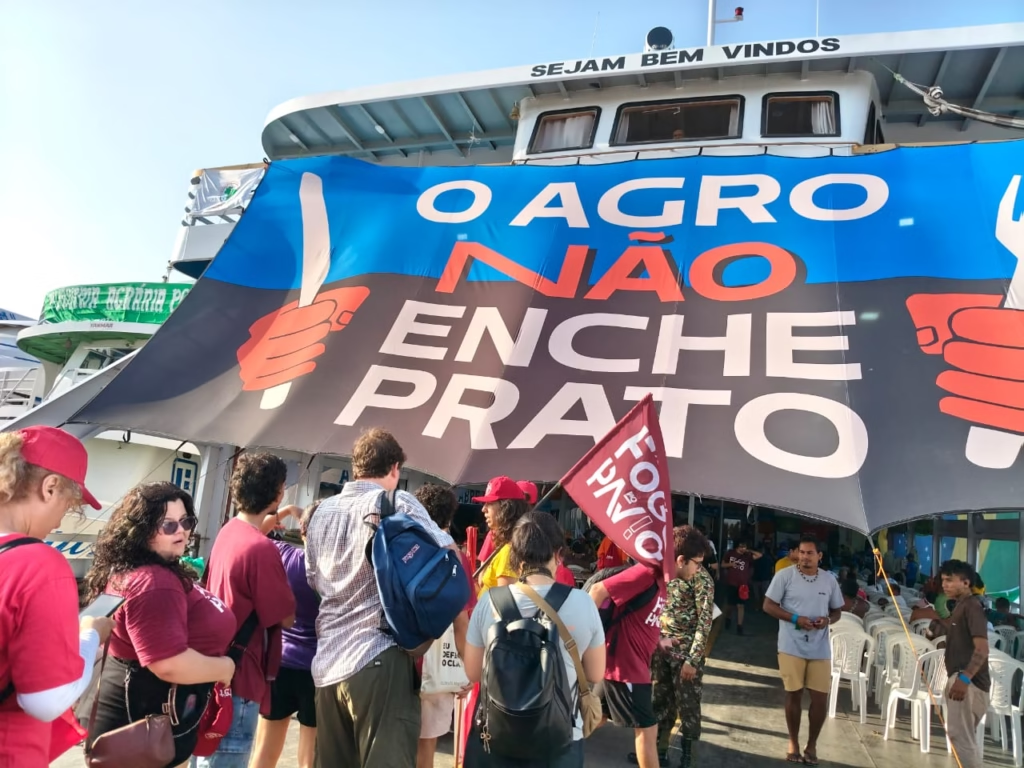
More than 5,000 people from 62 countries will navigate the rivers surrounding the COP30 host city in a major political action on the waters. One of the boats will carry leaders such as Raoni as part of the “Caravan of the Response.” Belém, Pará, Brazil — This Wednesday, November 12, starting at 9:00 a.m., more than 200 boats carrying approximately 5,000 people will gather in Guajará Bay, in front of the capital of Pará, in one of the most symbolic moments of the People’s Summit, a parallel event to COP30. The People’s Summit River Flotilla will bring together caravans that departed from other municipalities, states, and countries to denounce false climate solutions and to announce that the answer to a sustainable world lies with the peoples of the waters, the forests, and the urban peripheries, who resist through collective, agroecological, and ancestral practices. The flotilla will depart from the Federal University of Pará (UFPA), located in the Guamá district and home to the People’s Summit, and will travel along the Guamá River, which then becomes the Guajará River, until reaching Vila da Barca, a stilt-house community that constitutes a social enclave, as part of its homes lack basic sanitation. The community has resisted for decades against real estate speculation and the neglect of public authorities. In the city’s preparation for COP30, Vila da Barca was slated to receive a sewage treatment facility serving a nearby middle-class neighborhood that has been recently beautified to enhance the city’s tourist image. As a result, the area has become a clear example of the contradictions of conferences that make misguided decisions while ignoring those most affected by extreme climate events. These contradictions will be exposed through banners and signs displayed on large and small vessels along a 4.5-nautical-mile route. The flotilla is expected to depart from four ports near UFPA and sail for approximately two hours, a duration that takes tidal conditions into account. “We are aligned, and we believe it will be historic,” said Iury Paulino, a member of the People’s Summit Political Committee and coordinator of the Movement of People Affected by Dams (MAB). River damming is among the corporate actions and infrastructures denounced for causing impacts that increasingly contribute to the climate crisis, including changes in river courses, sedimentation, species extinction, flooding of areas that were once forest, and the displacement of communities that safeguard preservation practices. These impacts are also faced by fishing communities that maintain a longstanding cultural relationship with the sea. Riverine and fishing peoples around the world are directly affected by the contamination of rivers and coastal areas caused by mining activities and chemical spills. In Brazil, the collapse of Vale’s dams in Mariana (2015) and Brumadinho (2019) caused hundreds of deaths, destroyed communities, and inflicted severe environmental damage, contaminating rivers and ecosystems. In Ecuador, the rupture of the SOTE oil pipeline, operated by a state-owned company, spilled more than 25,000 barrels of crude oil into the Esmeraldas River in March 2025, contaminating drinking water, rivers, and coastal communities. For this reason, movements and organizations of the People’s Summit are uniting to amplify, over the waters, a collective outcry against COP decisions that perpetuate this model of territorial exploitation, and against corporations that exert strong influence in conference decision-making spaces to prevent the adoption of more ambitious targets for reducing natural resource extraction, as well as for mitigation and damage repair, within the Nationally Determined Contributions (NDCs) established under the Paris Agreement. People’s Summit at COP30 – Program Overview 📍 November 12 (Wednesday) — The morning will be marked by the river flotilla on the Guamá River, as boats from various riverine communities arrive in Belém and join national and international delegations, with the participation of approximately 150 vessels. From 3:00 p.m. to 5:00 p.m., delegations will be formally welcomed on the main stage, followed by a large public gathering for the official opening of the People’s Summit from 5:00 p.m. to 7:00 p.m. The first day will conclude with a major cultural concert on the main popular stage. 📍 November 13 (Thursday) — Thematic activities organized around the event’s convergence axes will begin. Workshops, dialogue circles, plenaries, and exchanges of experience will be guided by territorial knowledge, strengthening the connection between climate struggle and social justice. This initial phase aims to identify the main challenges faced by communities and to map solutions already being built in the territories. From 8:30 a.m. to 12:00 p.m., global plenaries will be held on Axes 1, 2, and 3: Sovereignty, Reparations, and Transition. The Children’s Summit and the People’s Fair will also take place. In the afternoon, from 2:00 p.m. to 6:00 p.m., Convergence Axis Linkage activities will be held, followed in the evening, from 7:00 p.m. to 10:00 p.m., by cultural activities, briefings on negotiations, and mobilizations. 📍 November 14 (Friday) — The third day will focus on consolidating the proposals that emerged in previous activities. This is the moment of political synthesis, when inputs raised by movements are organized into contributions that will form the final declaration. Working groups and thematic assemblies will shape the demands and priorities to be presented to the world. From 8:30 a.m. to 12:00 p.m., plenaries will address Axis 4 — Internationalism, Axis 5 — Cities, and Axis 6 — Women, with cultural interventions throughout the sessions and the Children’s Summit. In the afternoon, from 2:00 p.m. to 4:00 p.m., there will be Convergence Axis Linkage activities, the Assembly of Social Movements, and the seminar “Health and Climate.” From 4:00 p.m. to 6:00 p.m., the final plenary will present the syntheses of the axes and consolidate the People’s Declaration. 📍 November 15 (Saturday) — A large popular march will take place, a public and international action bringing together Indigenous peoples, quilombola communities, youth, urban and rural workers, feminist organizations, environmental collectives, trade unions, and international networks. The march expresses the collective voice of the People’s Summit and represents its most visible moment of popular mobilization, affirming that climate justice is inseparable from
Unity in Struggle: Affected Peoples from 42 Countries Unite Demands for Climate Justice and the Rights of Affected Communities

Context: Amazonian experiences precede the construction of the People’s Charter The historic mobilization for Global Climate Justice in Belém gained even greater strength in the days leading up to the official opening of the People’s Summit. The agenda included a series of Amazonian experiences, connecting representatives from hundreds of organizations that will participate in the People’s Summit with local realities, in a process of immersion and exchange that precedes the political drafting of the Charter to be delivered at the Summit. This immersion reinforces the central understanding of the movements that the climate crisis is not a technical issue, but a political and social one. As reiterated by Eduardo Giesen Amtmann, spokesperson for Axis 4 of the People’s Summit and professor of Political Ecology, in alignment with the position of the organizations, “the climate crisis is not a natural phenomenon, but the result of a system that exploits the planet and concentrates wealth, extractivist capitalism. Average surface temperatures on Earth are the highest ever recorded in history because of this political and economic system. That is why we strongly reject ‘capitalist solutions’ such as carbon markets, and demand that the response be focused on the ethical value of life and nature, not on putting a price on them.” It is in this spirit of urgency and rejection of false solutions that the 4th International Meeting of People Affected by Dams and the Climate Crisis, organized by MAR and MAB, has been immersed in consolidating its agenda for the People’s Summit. Global articulation for the construction of the political charter The fourth day of the Meeting began this Monday (the 10th) with the clear objective of producing the political charter that will centralize the urgent demands of people affected by dams and by the climate crisis. A moment of culture and politics, accompanied by the music of the band Mistura Popular, prepared participants for the Group Work on the Struggles of Resistance and Achievements of Affected Peoples. In a pre-debate dynamic rich in symbolism, representatives from all continents brought objects and symbols from their struggles, weaving a living map of identities and territorial resistance. The urgency of the debate was reinforced by the presence of Pedro Arrojo, UN Special Rapporteur on the Human Rights to Safe Drinking Water and Sanitation. Arrojo, whose most recent work included investigating violations in Peru, among other scenarios of water conflict and rights violations, echoed the global denunciation raised by the Movement against the systematic exploitation of rivers and the human rights violations promoted by megaprojects. Condensing global struggles and denunciations: the unanimity of harms The Meeting continued with the consolidation of experiences and struggles from the international movement. Representatives from different continents, including delegates from the Democratic Republic of the Congo, Thailand, Palestine, Cuba, Mexico and Indonesia, were divided into five working groups to document and systematize struggles and resistance strategies. The group discussions revealed unanimity in the harms suffered, centered on water privatization, mineral extraction and the construction of megaprojects. This “hydro-necropolitics” produces perverse and ironically contradictory outcomes. On this point, Mexican activist and affected person Ana Valdez emphasized that in her country the people experience “a centrifugation of rights.” Large corporations dam rivers, resulting in water scarcity and contamination for communities, and in many cases death. The same reality was described by Malee Hettarakun from Indonesia, who reported corporate violence in her territory, while Augustin Louis Lokorbo from the Democratic Republic of the Congo highlighted the importance of exchange“Our oppressors operate globally, and we, the affected peoples, must respond at the same level. It is only through this intercontinental exchange of knowledge and strategies that we can confront the mechanisms used by corporations and governments to violate our rights.” The systematization of these denunciations and experiences of struggle forms the basis for consolidating the International Movement and for drafting the Charter that will be presented at the People’s Summit. 📍Program – November 11, 2025, Tuesday9:00 am – Report-back from group work on the struggles and resistance of affected peoples3:00 pm – Presentation of the construction of the International Movement8:00 pm – Gathering and evening of strengthening the transformative struggle Photo: Joyce Silva / MAB
Cúpula dos Povos Barqueata Brings More Than 200 Boats to Guajará Bay in Belém in a Historic Act for the Amazon and Climate Justice

Around 5,000 people from 60 countries are expected to navigate the rivers surrounding the host city of COP30 in a grand political act on the waters. One of the boats will carry leaders such as Raoni in the “Caravan of the Response”. Belém (PA) — On November 12, starting at 9 a.m., more than 200 boats carrying around 5,000 people are expected to gather in Guajará Bay, in front of the capital of Pará, in one of the most symbolic moments of the Cúpula dos Povos, a parallel event to COP30. The Cúpula dos Povos Barqueata will bring together caravans that departed from other municipalities, states and countries to denounce false climate solutions and to announce that the response to a sustainable world comes from the peoples of the waters, forests and urban peripheries, who resist through collective, agroecological and ancestral practices. The barqueata will begin at the Federal University of Pará (UFPA), the territory of the Cúpula dos Povos, and will follow along the Guamá River, which then becomes the Guajará River, until reaching Vila da Barca, a stilt-house community that is a social enclave, where part of the population lives without any sanitation. The area reflects decades of residents’ resistance to real estate speculation and the lack of attention from public authorities. In the preparation of the city for COP30, Vila da Barca was slated to receive a sewage treatment station for a middle-class neighborhood that has been beautified in recent months to compose the city’s tourist landscape. As a result, the area has become an example of the contradictions of conferences that make misguided decisions while ignoring those most impacted by extreme climate events. These contradictions will be exposed through banners and signs displayed on large and small boats along a route of 7 nautical miles. The plan is to depart from four docks near UFPA and navigate for about two hours, a time estimate that takes into account tidal strength. “We are aligned and we believe this will be historic,” says Iury Paulino, a member of the Political Commission of the Cúpula dos Povos and coordinator of the Movement of People Affected by Dams (MAB). The damming of rivers is among the corporate actions and infrastructures denounced for causing impacts that increasingly contribute to the climate crisis, such as changes in watercourses, silting, species extinction, flooding of areas that were once forest, and the expulsion of communities that safeguard preservation practices. These impacts are also faced by fishers who maintain a historic cultural relationship with the sea. Riverine and fishing communities around the world are directly affected by contamination of rivers and coastal areas caused by mineral extraction and chemical spills. In Brazil, the collapse of Vale’s dams in Mariana (2015) and Brumadinho (2019) caused hundreds of deaths, the destruction of communities and severe environmental damage, contaminating rivers and ecosystems. In Ecuador, the rupture of the SOTE oil pipeline, operated by a state-owned company, spilled oil into the Esmeraldas River in March 2025, releasing more than 25,000 barrels of crude and contaminating drinking water, rivers and coastal communities. For this reason, movements and organizations of the Cúpula dos Povos are joining forces to make their denunciations echo over the waters against COP decisions that maintain this model of territorial exploitation, and against corporations that exert strong influence within conference decision-making spaces to block more ambitious targets for reducing resource extraction, mitigating impacts and ensuring reparations in the NDCs (Nationally Determined Contributions), which are each country’s commitments to reduce greenhouse gas emissions and adapt to climate change under the Paris Agreement. Raoni Among the boats confirmed for the barqueata is the Caravan of the Response, a mobilization that is traveling more than 3,000 kilometers between Sinop (MT) and Belém (PA) with over 300 Indigenous, riverine, quilombola and peasant leaders. With the support of the Cúpula dos Povos, the mobilization organized by the Chega de Soja Alliance, a coalition of around forty Brazilian and international organizations, departed from Santarém on Sunday, November 9. The Caravan retraces the route of the so-called “soy corridor,” denouncing the impacts of agribusiness and major infrastructure projects, such as Ferrogrão and the waterways of the Arco Norte, on traditional territories and ways of life. Ferrogrão is a planned 933-kilometer railway intended to connect Sinop (MT) to Miritituba (PA) to transport grains, mainly soy and corn, from Brazil’s Central-West through the Arco Norte. Its implementation, however, threatens conservation units, Indigenous lands and intensifies deforestation in the Amazon. During the act, historic leaders of the Indigenous struggle in Brazil are expected to be on board, including Chief Raoni Metuktire, leader Alessandra Korap Munduruku, and representatives of the Kayapó, Panará, Borari, Tupinambá, Xipaya, Arapiun, Huni Kuin and Kayabi peoples, among others. Their presence symbolizes the bond between the peoples of the Xingu and Tapajós regions, where the advance of soy production and export infrastructure has caused environmental destruction and rights violations. “The peoples are the response” Pedro Charbel, from the Chega de Soja Alliance, said the Caravan synthesizes what the movement calls denunciation and announcement. “Our struggle is against these corporate ports, against waterways and against Ferrogrão, but we also have the response. The response is agroecology, healthy food without poison, solidarity with the people, community kitchens and the free distribution of food because food is a right, not a commodity. The response is infrastructure built by the people, not infrastructure that benefits agribusiness billionaires. The response is living territories, demarcated lands, standing forests and clean rivers with healthy fish, not rivers contaminated with mercury and soy.” The Cúpula dos Povos, which brings together more than 1,200 movements, organizations and networks from Brazil and abroad, emphasizes that the Barqueata represents the spirit of the conference. “It is not just a protest, it is a fluvial manifesto. The waters of the Amazon are carrying the voices the world needs to hear, those who defend life, territories and the climate,” says Lider Gongora, a member of the Political Commission of the Cúpula dos Povos, an Ecuadorian activist
The Officialization of Peoples’ Struggle and the Emergence of a Major Global Movement
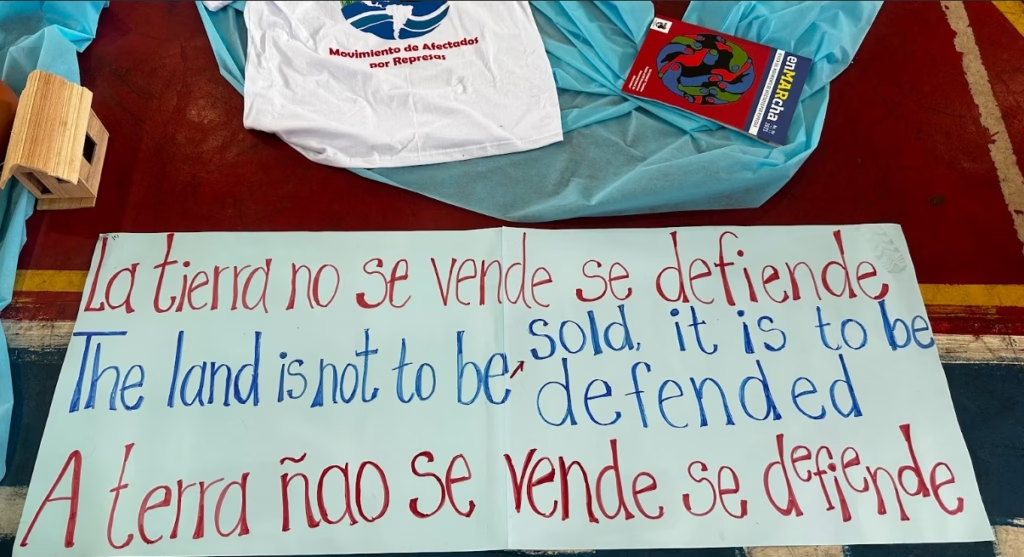
The central focus of the agenda on the 5th day of the IV International Movement of Communities Affected by Dams and the Climate Crisis is the officialization and presentation of the consolidation of this articulation, which brings together the grassroots bases of MAR and MAB and mobilizes organizations and their leadership from 42 countries across five continents. This day represents a strategic leap in the struggle. The formalization of the global movement not only unifies tactics of resistance against megaprojects across different continents, but also projects the demand for comprehensive reparations and territorial sovereignty as non-negotiable issues in international arenas such as the People’s Summit. This unity is the popular response to the transnational operations of corporations and predatory development models that exploit water, energy and life on a planetary scale. The day is dedicated to systematizing struggles and forging unity of action within the International Movement of Affected Peoples, with a focus on supply and peoples’ sovereignty. Program – November 11: Construction and Strengthening 9:00 am – Report-back from group work on the struggles and resistance of affected peoplesSystematization of denunciations and resistance strategies from 42 countries, serving as the basis for finalizing the Political Charter. 3:00 pm – Presentation of the construction of the International Movement – Meeting with CONABDebate on strategy and next steps for consolidating global unity of action, with the participation of representatives from CONAB to discuss the role of the Company in food security and supply. 8:00 pm – Gathering and evening of strengthening the transformative struggleClosing of the debate cycle, preparing the groundwork for the transition to the People’s Summit. Panel highlight The afternoon debate will include the participation of representatives from the National Food Supply Company (CONAB), highlighting the link between the struggle for land and water and food production in the context of the climate crisis. Confirmed participants include Rosanna Costa, Regional Superintendent of CONAB in Pará; Arnoldo Campos, Director of Operations and Supply of CONAB Brazil; and Karine Fernandes, Communications Advisor at CONAB Brazil. Transition to the People’s Summit (November 12) The activities will culminate on Wednesday (the 12th) with the River Boat Protest on the Guamá River (9:00 am to 2:00 pm), the first major popular action marking the opening of the People’s Summit at COP30. Photo: Samara Silva / EficazPress