
Mobilization of Peoples for Land and Climate: REPAM Coordination Participates in Chamber Seminar on COP30 Directions
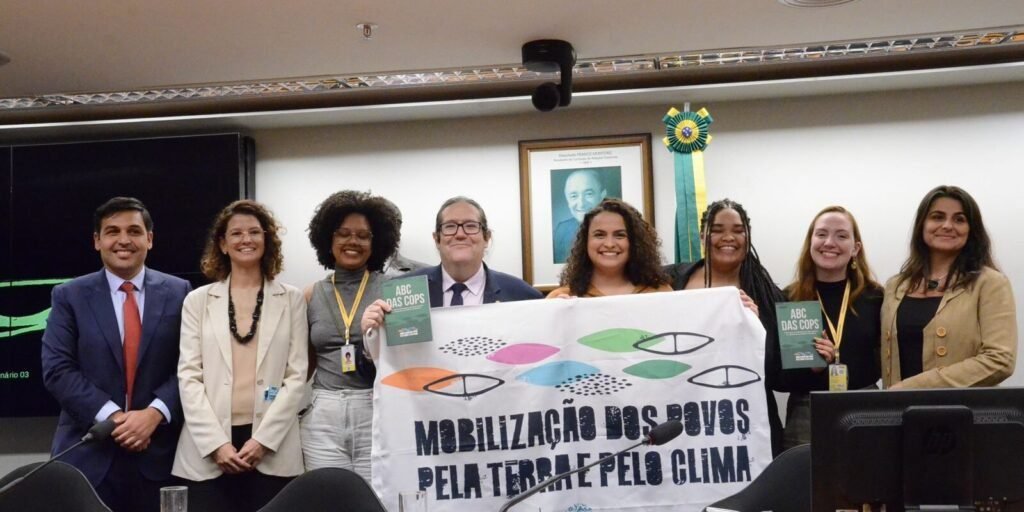
Mobilization of Peoples for Land and Climate: REPAM Coordination Participates in Chamber Seminar on COP30 Directions The Environmentalist Mixed Parliamentary Front, through its Climate Working Group, held a seminar on Tuesday, May 6, at the Chamber of Deputies to present lessons from the last Climate Conference and discuss pathways for the upcoming COP30, scheduled for November in Belém (PA). The event brought together representatives from the federal government, parliamentarians, and various civil society organizations to emphasize the importance of broader and more effective participation in the conference’s preparatory processes. Participants included diplomat Pedro do Nascimento Filho from the Ministry of Foreign Affairs; Monique Ferreira, Chief of Staff for the COP30 Presidency at the Ministry of Environment; representatives from the National Youth Climate Coalition (Conjuclima), the Alana Institute, Plataforma Cipó, the Black Voices for Climate Network, as well as parliamentarians such as Tarcísio Motta (PSOL-RJ). During the seminar, Mayara Lima, communicator for the project Mobilization of Peoples for Land and Climate, coordinated by REPAM toward COP30, highlighted the need to decentralize the climate debate and ensure that the conference agenda reaches the grassroots level. She presented the ABC of COP guide, created to facilitate access to information and strengthen the actions of territories and traditional populations. “You cannot influence what you do not understand. If information remains restricted to diplomats and small groups, how will communities build pathways for real participation?” she asked. Mayara Lima also emphasized the ongoing efforts by civil society to ensure meaningful participation in climate discussions, even outside official COP30 spaces. She cited initiatives such as the People’s Summit, the COP of the Lowlands (COP das Baixadas), and the People’s COP (COP do Povo), which will take place in parallel with the official conference in Belém. “We know civil society will not be fully inside COP30, so these autonomous spaces are essential for expanding influence and strategically organizing the voices of the territories,” she stated. Thalia Silva, coordinator of Conjuclima, also demanded greater space for youth in international negotiations. “COP29 showed that we, as youth, are not asking for a seat at the table. Now, we demand to be part of the decisions and negotiations,” she said. The seminar was organized by the Participatory Legislation and Environment Committees of the Chamber, with support from the Environmentalist Parliamentary Front, following a request from deputies Ivan Valente (PSOL-SP) and Talíria Petrone (PSOL-RJ).
FASE joins social movements in building the People’s Summit Toward COP30 The meeting in Rio de Janeiro mobilized organizations and civil society to outline strategies at national and international levels.
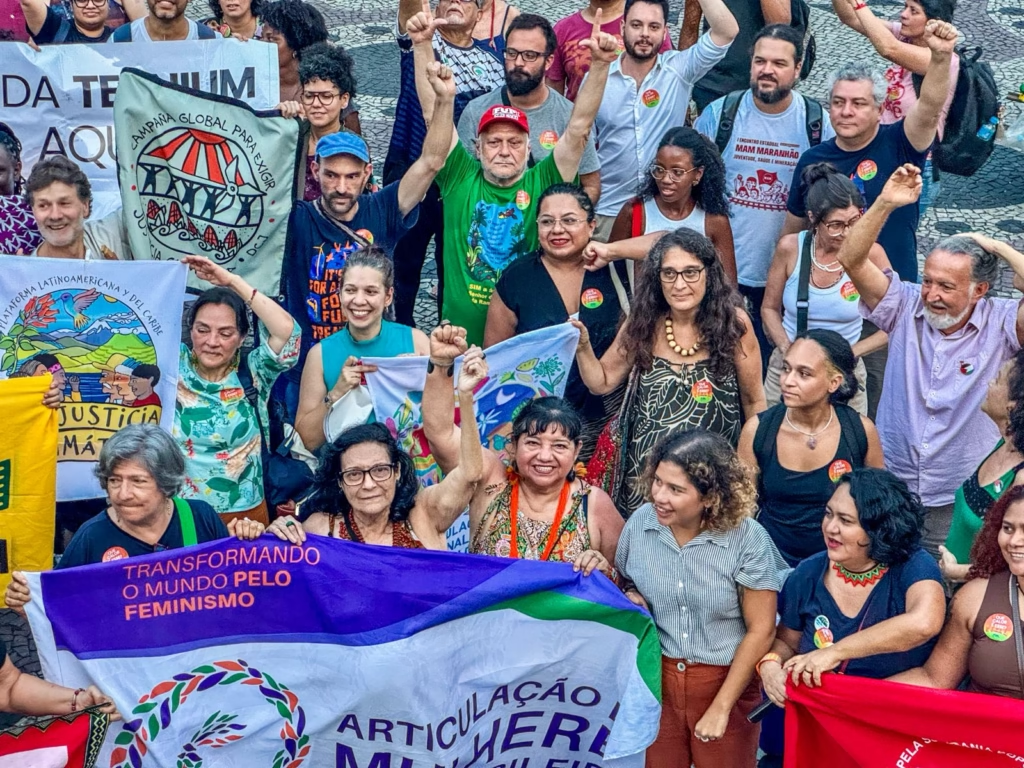
Paula Schitine07/02/2025 3:53 pm The People’s Summit Toward COP30 met throughout the week in Rio de Janeiro to expand national and international mobilization strategies. The main objective was to define the direction of the Summit’s international advocacy toward the 30th United Nations Conference on Climate Change, which will take place in Belém, Pará, in November this year. The city of Rio de Janeiro holds fundamental importance, as it previously hosted Rio 92 and Rio+20, conferences and key spaces for global environmental, climate, and social debates. On Tuesday (4), the Mobilization of Peoples for Land and Climate was organized during the Political-Cultural Act held at Cinelândia, in downtown Rio de Janeiro. On the 3rd and 4th, the meeting of the operational group of the People’s Summit also took place, with the participation of representatives of movements from Africa, Asia, the Americas, and Europe, who discussed strategies for influencing climate negotiations on the road to COP30. Around 500 representatives of social movements from different parts of the world were present. Representing FASE were Executive Director Letícia Tura, Coordinator of the Policy and Alternatives Unit (NuPA) Maureen Santos, and Coordinator of FASE Amazonia Sara Pereira. “At this meeting, the key understanding was that there is no way to promote climate justice without promoting social justice. So this is not only an environmental or climate discussion, it is above all about the reality of peoples,” said Sara Pereira. “It is important that the population understands this and places itself in this struggle for a transition not only of the energy matrix, but of the economic matrix, a model built from the initiatives of peoples from urban peripheries, quilombos, the countryside, the waters, and the forest, not only in Brazil, not only in the Amazon, but across all continents and throughout global civil society,” summarized the Coordinator of FASE Amazonia. The People’s Summit Toward COP30 is a process of convergence among organizations and movements of women, trade unions, Indigenous peoples, family farmers and peasants, quilombola communities, traditional peoples and communities, peoples of African-based traditions, Black communities, youth, interfaith groups, environmentalists, workers, independent media activists, cultural workers, students, residents of favelas and urban peripheries, LGBTQIAPN+ communities, persons with disabilities, human rights defenders, advocates for children, adolescents and intergenerational justice, from cities, the countryside, forests, and waters, toward the realization of the People’s Summit as an autonomous space in relation to COP30. The space has been organized since August 2023 and brings together social and popular movements, coalitions, collectives, networks, and civil society organizations from Brazil. Its objective is to strengthen popular organizing and converge unity agendas across socio-environmental, anti-patriarchal, anti-capitalist, anti-colonial, anti-racist, and rights-based struggles, respecting their diversity and specificities, united by a future of well-being and buen vivir. FASE is one of the organizations building the People’s Summit through the networks in which it operates, such as the National Agroecology Articulation (ANA), the Carta de Belém Group, and the Pan-Amazonian Social Forum. It is also present in the Amazon, where it has worked for 30 years alongside Indigenous peoples, traditional communities, riverside populations, and peoples of the countryside, forests, waters, and cities. FASE communicatorOriginally published on the FASE portal HERE